Cave paintings are a type of parietal art, it was found on the wall or ceilings of caves. Its includes petroglyphs or engravings. The term usually implies prehistoric origin, but cave paintings can also be of recent production. Cave paintings are more than 44,000 years old. The oldest type of cave paintings are hand stencils and simple geometric shapes.
Some of the prehistoric cave paintings:
Magura Cave is located in the northwest of Bulgaria , it contains a full of cave paintings and painted with bat excrement that date from 8000-4000 years ago . . An excess of 700 paintings has been discovered in the large cave. Cueva de las Manos is located in Patagonia in the southern part of Argentina and contains cave paintings that were created between 13,000 and 9,000 years ago. Serra-da-Capivara is a national park in Brazil which has the largest and the oldest concentration of prehistoric paintings in the Americas. Laas Geel contain some of the earliest known cave paintings in the Horn of Africa. These are some important old cave paintings.
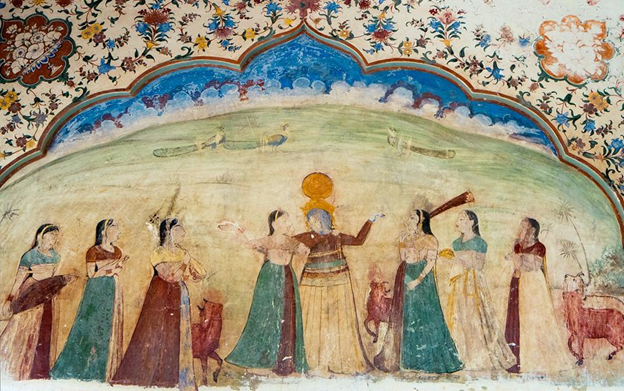
Most cave art consists of paintings made with either red or black pigment. The reds were made with iron oxides (hematite),whereas manganese dioxide and charcoal were used for the blacks. Executed mainly in red and white with the occasional use of green and yellow, the paintings depict the lives and times of the people who lived in the caves, including scenes of child birth, communal dancing and drinking, religious rites and burials as well as indegeneous animals. The most notable thing about cave art is that the predominant colours used are black(often from charcoal, soot or manganese dioxide) yellow ochre(often from limonite),red ochre(hematite, or baked limonite)and white (kaolin clay, burnt shells, calcite, powdered gypsum, or powdered calcium carbonate).The stable temperature and humidity in caves, a lack of human contact, and long lasting painting materials have combined to allow many ancient cave paintings to survive in nearly pristine condition.
In art, is a dog just a dog? Certainly not in European art history, where a canine on canvas can contain multitudes—representing anything from fidelity to treachery to seduction. And while these contradictory readings may seem to muddy the message of a given painting, they are also evidence of the long and rich history of animal symbolism in Western art. While humans and animals occupy the same earth, we inhabit different worlds, each having its own ways of being. Yet, artists depicting animals cast bridges across divides to the non-human world allowing them to flourish outside one’s own expectations. The first cave depictions of different beasts were mainly inspired by hunting. Remarkable for their realism and liveliness, a recent study determined that these drawings were actually better at accurately depicting the way four-legged animals walk than artists from the 19th and 20th centuries
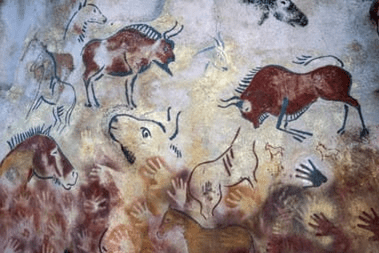
The simplest and oldest form of self-expression found in prehistoric caves is finger marking, or tracing, sometimes called “finger-fluting”. This ancient art, seen on soft clay walls, usually consists of formless squiggles but can also depict animal and even humanoid figures. Good examples can be seen at Altamira, Antillana del Mar, Baume Latronne, Cosquer, Koonalda (Australia) and Rouffignac.
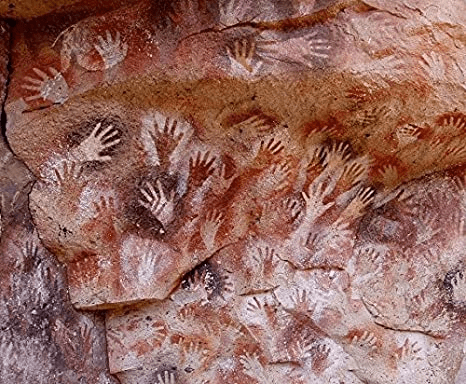
Handprints are one of the most common images of rock art, and appear in Stone Age caves throughout the world, including Sulawesi (Indonesia), Cosquer (France), Fern Cave (Australia), Elands Bay Cave (South Africa), El Castillo (Spain), Gargas (France), Maltravieso (Spain), Cueva de las Manos (Argentina), Altamira (Spain), East Kalimantan Caves (Borneo) and many others. According to recent analysis, the majority of painted hands in caves belong to women. There are two basic types of handprint: painted prints or stencilled silhouettes. Either the hand was painted (usually with red, white or black pigment) and then applied to the rock surface, producing a crude image of the hand; or the hand was placed on the wall or ceiling and pigment was then blown through a hollow tube over it, leaving behind a silhouette of the hand on the rock. Sometimes the stencil was made simply by painting around it with a pad dipped in pigment.
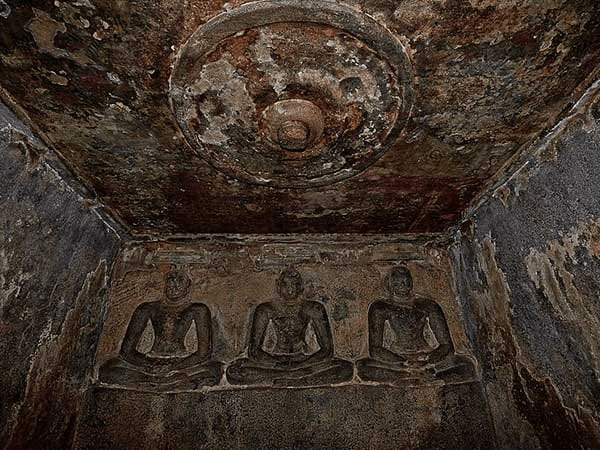
India is known for its mind-blowing cultural heritage which holds the roots of Indian art which can be traced by the rock-cut structures and cave paintings. Paintings and drawings became the oldest art style by human beings, to express themselves using the cave walls as their canvas. Ajanta Caves has the oldest Indian paintings. Interestingly, these paintings are made around the 1st century BC. Interestingly, Ajanta cave was built in two-phases. One around the 2nd century BC and the other one around 400-650 BC. The Ajanta Portraits owe their life primarily to Mahayana sector of Buddhism. Buddha’s life is depicted in the form of various images, drawings and other artistic depictions. They are universally called the masterpieces of Buddhist art.
Ellora is a very well known UNESCO World Heritage site, which is located in Maharashtra. There are almost 100 caves at the site, all excavated from the basalt cliffs Chandigarh. It is one of the world’s largest rock-cut monastery cave which features the Hindu, Buddhist, and Jain temples, and artworks which dates back to 600 – 1000 CE period. You should not want to miss the famous Kailash or Kailasanatha, largest of the rock-cut Hindu temples at the Ellora caves. It is considered as one of the most remarkable cave temples in the world. The most ancient cave paintings we are aware of are more than 40,000 years old. Exactly why our ancestors chose to make these paintings is a matter of speculation.
The most important Ancient cave paintings in TamilNadu:
Sittanavasal Cave is extremely popular amongst tourists for its wall paintings which are formed by using colours on the surface of the lime plaster. Several colours such as yellow, orange, blue, white, green and black are used to create lotus ponds, several figures, fish, buffaloes, elephants, etc. These paintings are carefully made keeping minute things in mind such as designs, borders and appropriate use of colours. Even though the paintings are in a deteriorating condition, they are still attract thousands of visitors on a regular basis. After all, it is not easy to create masterpieces which can thrive for centuries in the form of paintings made out of vegetable and mineral dyes using colours. It is certainly objectionable to bypass this remarkable beauty if you are in and around the Pudukottai district of Tamil Nadu.
Why cave art was painted is a mystery. However, images created the world we lived in and the world to come. Art, as a form to express an idea, is still going strong now. If we feel that past efforts predict future efforts, then the possibilities are endless. Images in any form are a window unto the past and a door to the future.
Written by Kanishga B, Mahisharthi V, Karunya A, Jamunadevi R, Gayathree Prabha, Rupashree, Sindhu S, Abinaya B.
 TEAM VARNAM