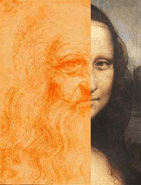
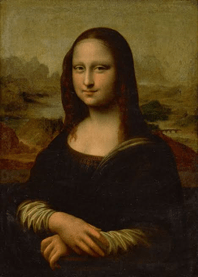
One of the most sought-after painting by Leonardo da Vinci, Mona Lisa was painted five centuries ago (1503 – 1519). Today, it hangs behind a highly protective bulletproof glass inside the Louvre Museum. It is regarded as the most famous painting in the world, drawing thousands of admirers from all corners of the world every day. It has its room and receives mails from fans all over the globe. Here are five mysteries which surround this painting.
Mona Lisa Mystery #1: Who was Mona Lisa?
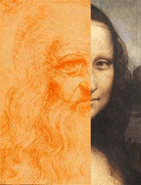
Over the past century, it has been proposed that Mona Lisa was a noblewoman – Isabella d’Este, Others have stared at that unsettling visage and seen the face of a man – Leonardo da Vinci himself, or the man who was for 20 years his assistant and perhaps his lover, Gian Giacomo Caprotti. This theory stresses on the fact that Da Vinci was gay and this painting was a shout out for his rights and that was the reason to paint a man as our woman, Monalisa.
Mona Lisa Mystery #2: The Broken Backdrop
The distant, dreamlike vista behind the Mona Lisa’s head seems to be higher on the right-hand side than on the left. It is hard to see how the landscape would join up. This is subliminally unsettling: Mona Lisa appears taller, more erect, when one’s gaze drifts to the left than when it is on the right.
Mona Lisa Mystery #3: The Bewitching Smile
In 2000, scientists at Harvard University put forward a neurological explanation for Mona Lisa’s elusive smile. When a viewer looks at her eyes, the mouth is in peripheral vision, which sees in black and white. This serves to accentuate the shadows at the corners of her mouth, making the smile seem broader. But the smile diminishes as soon as you look straight at it. It is the variability of her smile, the fact that it changes when you look away from it, that makes her seem so alive, and so mysterious.
Mona Lisa Mystery #4: The Unknown Bridge
The Mona Lisa’s background landscape seems unreal, but the bridge might be one that Leonardo knew. It is usually said to be Ponte Buriano in Tuscany, but in 2011 a researcher claimed that it depicts the Bobbio bridge over the Trebbia, which was washed away in a 1472 flood. Another study claimed that the number 72 could be seen in the brushstrokes on the bridge.
Mona Lisa Mystery #5: Da Vinci’s Obsession
Leonardo da Vinci worked on the painting for four years, and possibly at intervals after that. Strangely, he always took it with him when he travelled, and he never signed or dated it. The picture went with him when, towards the end of his life, he moved to France. It was sold to his last patron, King François I, and remained out of sight in the royal collection for almost 200 years. In 1799 Napoleon, then first consul of France, came across the painting and commandeered it for his bedroom. It was only in 1804 that the Mona Lisa went on public display – in the newly founded Louvre museum. At that time, and for decades afterwards, it was not seen as particularly interesting, but in the middle of the 19th century Leonardo’s stock as an artist slowly rose. He came to be seen as the equal of the two acknowledged Renaissance greats, Michelangelo and Raphael. This new-found interest in Leonardo as a painter drew attention to his few known works. The Mona Lisa, easily accessible in the Louvre, became an object of interest to critics and aesthetes at just the time that a new and deeply sensual attitude to art was emerging in France.
Mona Lisa is a simple portrait of an ordinary woman dressed in a modest veil, dark robes, and without jewellery. It is the proof that “smile” is the most attractive accessory that can be worn!
Written by Akash Velanganni D, Oviya Shree S, Swasthika Y K, Kumararaja G, Shreya C S, Sushmitha, Sowmiya Sri S, Nikitha D and Darshan.
 TEAM VARNAM