1. The Terracotta Army
The Terracotta Army is a collection of terracotta sculptures depicting the armies of Qin Shi Huang, the first Emperor of China. It is a form of funerary art buried with the emperor in 210–209 BCE with the purpose of protecting the emperor in his afterlife.

The Terracotta Army was discovered on 29 March 1974 by a group of farmers—Yang Zhifa, his five brothers, and neighbor Wang Puzhi—who were digging a well approximately 1.5 kilometers (0.93 mi) east of the Qin Emperor’s tomb mound at Mount Li(Lishan),a region riddled with underground springs and watercourses. For centuries, occasional reports mentioned pieces of terracotta figures and fragments of the Qin necropolis – roofing tiles, bricks and chunks of masonry. This discovery prompted Chinese archaeologists, including Zhao Kangmin, to investigate, revealing the largest pottery figurine group ever found. A museum complex has since been constructed over the area, the largest pit being enclosed by a roofed structure. The terracotta army figures were manufactured in workshops by government laborers and local craftsmen using local materials. Heads, arms, legs, and torsos were created separately and then assembled by luting the pieces together. When completed, the terracotta figures were placed in the pits in precise military formation according to rank and duty.
2. Laocoön and His Sons
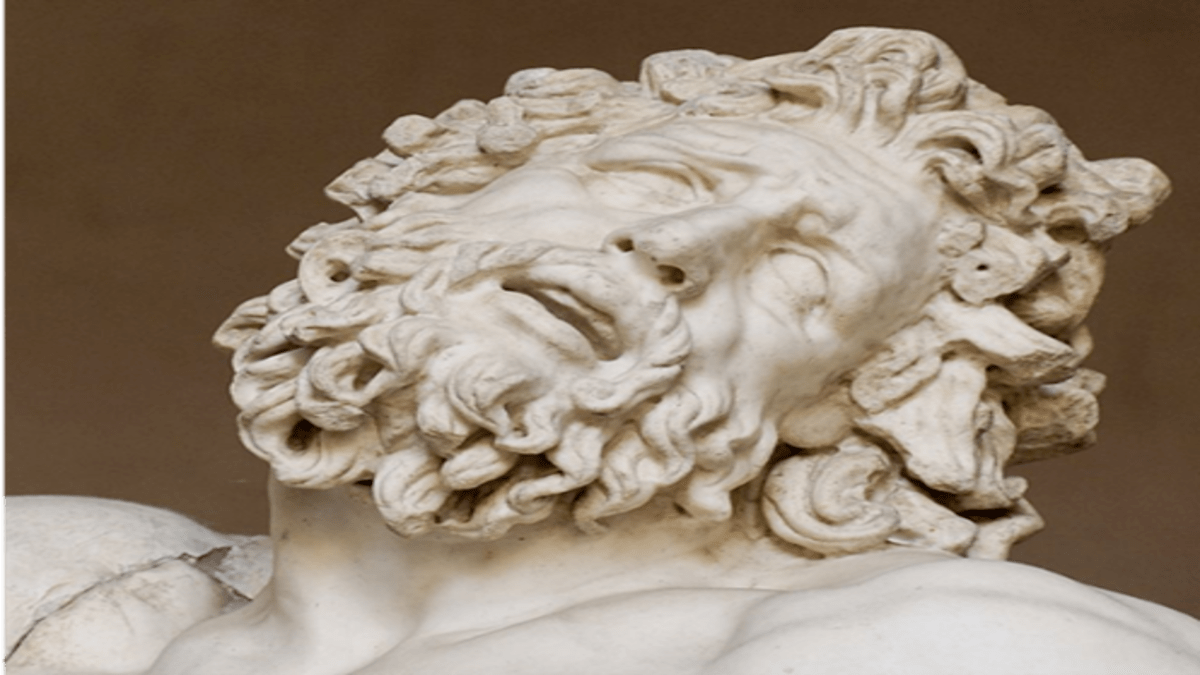
The statue of Laocoön and His Sons, also called the Laocoön Group, has been one of the most famous ancient sculptures ever since it was excavated in Rome in 1506 and placed on public display in the Vatican. The Laocoön and His Sons statue is made up of White Marble!

Laocoön was a seer and a priest of the god Apollo; he was the son of Agenor of Troy or, according to some, the brother of Anchises (the father of the hero Aeneas). Laocoön offended Apollo by breaking his oath of celibacy and begetting children or by having sexual intercourse with his wife in Apollo’s sanctuary. Thus, while preparing to sacrifice a bull on the altar of the god Poseidon , Laocoön and his twin sons, Antiphas and Thymbraeus (also called Melanthus), were crushed to death by two great sea serpents, Porces and Chariboea, sent by Apollo. A much better-known reason for his punishment was that he had warned the Trojans against accepting the wooden horse left by the Greeks.
3. Bust Of Nefertite
The Nefertiti Bust is a painted stucco-coated limestone bust of Nefertiti, the Great Royal Wife of Egyptian pharaoh Akhenaten. The work is believed to have been crafted in 1345 B.C.E. by Thutmose because it was found in his workshop in Amarna, Egypt. It is one of the most-copied works of ancient Egypt.

The core of the bust consists of limestone, over which a layer of stucco of varying thickness was applied for the final modelling. The consistency of the limestone as well as the thickness and the layer-by-layer application of the stucco were documented in CT scans produced in 2006 in collaboration with the Imaging Science Institute Charité – Siemens. These new scans provided several details not seen in previous images generated in 1992 at the Charité’s Virchow-Klinikum. The paints used here are in keeping with the well-known spectrum of ancient Egyptian natural pigments, including red ochre, yellow orpiment, green frit and carbon black, as well as the artificially produced “Egyptian blue”, applied in a variety of shades, to create the queen’s skin tone, for example. The multi-layered application of the paint was documented with the highest level of accuracy in contact-free tests carried out by the Rathgen-Forschungslabor of the Staatliche Museen zu Berlin in 2009.
4. Ecstasy of Saint Teresa
The Ecstasy of Saint Teresa is the central sculptural group in white marble set in an elevated aedicule in the Cornaro Chapel, Santa Maria della Vittoria, Rome. It was designed and completed by Gian Lorenzo Bernini .
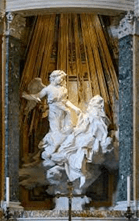
The Ecstasy of St. Theresa is considered by many as the apogee of Bernini’s oeuvre and is notable for the following qualities, Bernini’s St. Theresa is often described as a gesamtkunstwerk (a German word meaning “total work of art”) for the artist’s incorporation of a variety of elements: sculpture, painting, and lighting effects all presented in a theatrical setting. The Ecstasy of St. Theresa is not just a sculpture, but a total environment. Bernini designed the entire chapel, creating a veritable stage set complete with sculpted audience members.
5. Perseus with the head of Medusa
This marble statue shows the Greek demigod Perseus holding the head of Medusa. Perseus is standing in a triumphant pose as he has just beheaded Medusa. He holds the head of Medusa in his left hand by grabbing the venomous snakes on her head. The face of Medusa expresses horror as it has just been cut off. However, you can also still see the beauty of her face.Interestingly, Perseus is looking at her face, even though that should turn him into stone according to the myth (but the irony may be that this actually happened in this statue). Perseus is wearing the sandals of the Roman messenger god Mercury (Hermes in Greek) which allowed Perseus to fly. These sandals were made of gold by the god Vulcan (Hephaestus in Greek). Perseus also wears the cap of Hades, which could make him invisible.
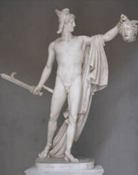
In his right hand, Perseus is holding a harpe sword, which is a sword with a sickle-like extension on one side of the blade. The sword was owned by Zeus, the father of Perseus. A robe hangs loosely over his arm. Notice that his left foot is standing in the front, while the heel of his right foot is lifted. In this way, Canova creates the sense that Perseus is moving forward.
Perseus and Medusa have been a popular subject in art. Famous artists have used their story as the inspiration for their artwork. Leonardo da Vinci created two version of the head of Medusa, but neither of them has survived. Caravaggio has painted the head of Medusa on a shield which is in the Uffizi Museum. Rubens also created two versions of the Head of Medusa, of which one is in the Kunsthistorisches Museum in Vienna. Various sculptures of Perseus and Medusa have also been made, such as one by Benvenuto Cellini.
Written by Mridhula R, Pujakaleeswari N, Avantheka S, Yatheswar, Sukitha, Subiksha Devadharshini S, Thilothika T, Kiruthika S.
 TEAM VARNAM