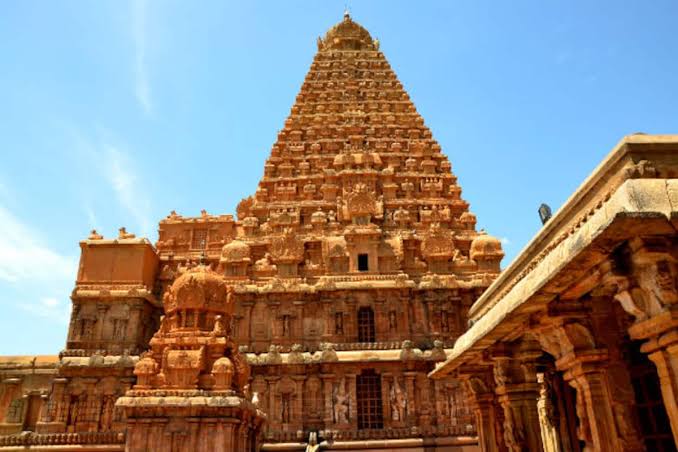
Peruvudaiyaar Kovil is a Hindu temple dedicated to Shiva which is also called as Brihadeeswarar temple. It is a Hindu temple dedicated to Shiva, also called Rajarajesvaram temple or Peruvudaiyār Kōvil temple. It is located on the south side of Kaveri river in Thanjavur in the Indian state of Tamil Nadu. The temple is part of the UNESCO World Heritage Site known as the “Great Living Chola Temples”, along with Brihadeeswarar Temple, Gangaikonda Cholapuram and Airavatesvara temple. The patron of the temple RajaRaja Chola has also arranged to make very large number of inscriptions in a highly detailed manner that has no precedence in the history of any other temple in the world. These inscriptions divulge some crucial information and secrets regarding temple construction and its different features.
History
The daily rituals to be conducted in the temple, the details of offerings and decorations to be made with a specific description of all the jewels donated to the temple, the methods of special worship on important days and several other crucial information regarding the administration of the temple. History says the 107 paragraphs inscribed were personally dictated by the king being seated in the royal bathing hall at the eastern side of the Palace. While none of the massive palaces built during the history of Cholas survives today, the fact that Brihadeshwara temple has managed to stand the test of time for more than a thousand years proves the superior accomplishment of Chola architecture and the patron’s incomparable devotion for Shiva.
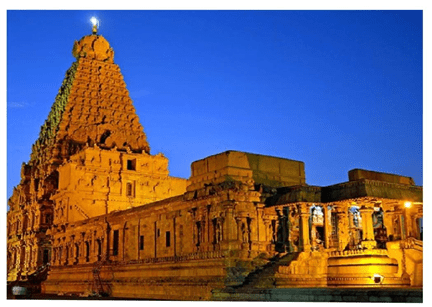
spectrum of Hindu temple styles continued to develop from the 5th to the 9th century over the Chalukya era rule as evidenced in Aihole, Badami and Pattadakal, and then with the Pallava era as witnessed at Mamallapuram and other monuments. Thereafter, between 850 and 1280 CE, Cholas emerged as the dominant dynasty. The early Chola period saw a greater emphasis on securing their geopolitical boundaries and less emphasis on architecture. In the 10th century, within the Chola empire emerged features such as the multifaceted columns with projecting square capitals. This, states George Michell, signaled the start of the new Chola style. This South Indian style is most fully realized both in scale and detail in the Brihadeshwara temple built between 1003 and 1010 by the Chola king Rajaraja I
CONSTRUCTION
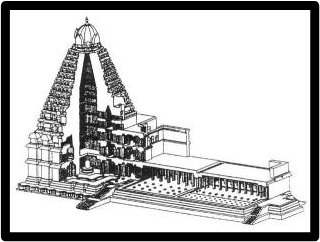
The Brihadeshwara temple plan and development utilizes the axial and symmetrical geometry rules. it’s classified as Perunkoil (also called Madakkoil), a giant temple built on the next platform of a natural or man-made mounds.The temple complex may be a rectangle that’s almost two stacked squares, covering 240.79 metres (790.0 ft) east to west, and 121.92 metres (400.0 ft) north to south. during this space are five main sections: the sanctum with the towering superstructure (sri vimana), the Nandi hall before (Nandi-mandapam) and in between these the most community hall (mukhamandapam), the good gathering hall (mahamandapam) and also the pavilion that connects the good hall with the sanctum (ardhamandapam).The temple complex integrates an oversized pillared and covered veranda (prakara) in its spacious courtyard, with a fringe of about 450 metres (1,480 ft) for circumambulation. Outside this pillared veranda there are two walls of enclosure, the outer one being defensive and added in 1777 CE by the French colonial forces with gun-holes with the temple serving as an arsenal. They made the outer wall high, isolating the temple complex area. On its east end is that the original main gopuram or gateway that’s barrel vaulted. it’s but half the scale of the most temple’s vimana. Additional structures were added to the initial temple after the 11th century, like a mandapa in its northeast corner and extra gopurams (gateways) on its perimeters to permit people to enter and leave from multiple locations.a number of the shrines and structures were added during the Pandya, Nayaka, Vijayanagara and Maratha era, before the colonial era started, and these builders respected the initial plans and symmetry rules. Inside the first temple courtyard, together with the most sanctum and Nandi-mandapam are two major shrines, one for Kartikeya and for Parvati. The complex has additional smaller shrines.The Brihadeshwara temple continued the Hindu temple traditions of South India by adopting architectural and ornamental elements, but its scale significantly exceeded the temples constructed before the 11th century. The Chola era architects and artisans innovated the expertise to rescale and build, particularly with heavy stone and to accomplish the 63.4 metres (208 ft) high towering vimana.
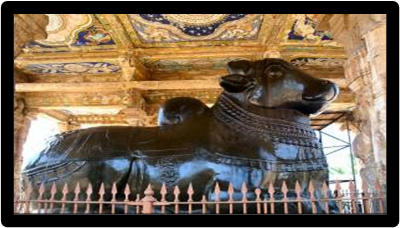
The temple faces east, and once had a water moat around it. This has been filled up. The fortified wall now runs around this moat. the 2 walls have ornate gateways called the gopurams. These are made up of stone and display entablature. the most gateways are on the side. the primary one is termed the Keralantakan tiruvasal, which suggests the “sacred gate of the Keralantakan”. The word Keralantakan was the surname of king Rajaraja who built it. a couple of 100 metres (330 ft) ahead is that the inner courtyard gopuram called the Rajarajan tiruvasal. this can be more decorated than the Keralantakan tiruvasal, like with its adhishthanam relief work narrating scenes from the Puranas and other Hindu texts.[28] The inner eastern gopuram ends up in an unlimited courtyard, during which the shrines are all signed to east–west and north-west cardinal directions. The complex are often entered either on one axis through a five-story gopuram or with a second access on to the massive main quadrangle through a smaller free-standing gopuram. The gopuram of the most entrance is 30 m high, smaller than the vimana. The main temple-related monuments and therefore the great tower is within the middle of this courtyard.Around the main temple that’s dedicated to Shiva, are smaller shrines, most of which are aligned axially. These are dedicated to his consort Parvati, his sons Subrahmanya and Ganesha, Nandi, Varahi, Karuvur deva (the guru of Rajaraja Chola), Chandeshvara and Nataraja.The Nandi mandapam incorporates a monolithic seated bull facing the sanctum. In between them are stairs resulting in a columned porch and community gathering hall, then an inner mandapa connecting to the pradakshina patha, or circumambulation path. The Nandi (bull) facing the mukh-mandapam weighs about 25 tonnes. it’s fabricated from one stone and is about 2 m tall, 6 m long and a couple of.5 m wide.The image of Nandi could be a monolithic one and is one among the biggest within the country.
INTRESTING FACTS ABOUT BRIHADEESHWARA TEMPLE
The big Tanjore temple is said to have more than hundred underground passages that connects to various other places. Nowadays, most of the passages are sealed. In the earlier days, the passages were used by sages, Kings and Queens to roam about different temples and places, especially during auspicious festivals like Deepavali, Maha Shivarathri and Makar Sankranti.The temple is said to have a huge cap stone on top of it, and the weight of the stone is said to be 80 tonnes. The Garbhagriha where the Shiva lingam is located is said to generate large amount of electromagnetic energy.The 80 tonne stone acts a repulsive force and channels the energy to the inner areas of the temple to sustain its piousness and divinity.The positive energy radiant within in the temple structure is said to have a calming, soothing effect both mentally and physically on the devotees.
The primary tower has a hollow shape and the stones are interlocked without any binding material, while they stand powerfully in their weight. Another miracle is the 216 ft hollow tower, without any binding material, has an ideal equilibrium and balance, despite all the natural disasters in 1000 years.
The Nandhi statue, sculptured during the Raja Raja Cholan period, kept growing in the size. It could be even because of the unique weather condition and to control its growth, it was kept aside and nailed to the grounds. However, the current statue before Lord Shiva is a single stone statue and was gifted by the Maratha rulers in the 17th-19thcentury.
CONCLUSION
It will took almost an hour to roam around the temple complex, to look at the sculptures, relook at them and marvel at the murals and frescoes. All this time we may keep on wondering the might of the ruler Raja Raja Chola who had the vision to create something so grand. The place is also referred to as the “Great Living Chola Temples” and the temple is still living as the symbol of the Chola rule.
Written by Hema Bharathi, Noufar Mohamed, Jaswant Kumar, Paval, Divya, Elakkiya.
 TEAM VARNAM