
The origin of Indian art can be traced to prehistoric settlements in the 3rd millennium BC, to the Chalcolithic Age as is evident from the progress of the Indus Valley Civilization. The buildings of Indus Valley culture though made of bricks, possessed little aesthetic material. On its way to modern times, Indian art has had cultural influences, as well as religious influences such as Hinduism, Buddhism, Jainism, Sikhism and Islam. Despite this complex mixture of religious traditions, generally, the prevailing artistic style at any time and place has been shared by the major religious groups. In historic Indian art, sculpture in stone and metal, mainly religious, has survived the Indian climate better than other media and provides most of the best remains. In fact, we hardly come across any architectural remains of the pre-Mauryan period which have reached artistic value. This may be because the buildings were not made of stone during this period. Many of the most important ancient finds that are not in carved stone come from the surrounding, drier regions rather than India itself. Indian funeral and philosophic traditions exclude grave goods, which is the main source of ancient art in other cultures.
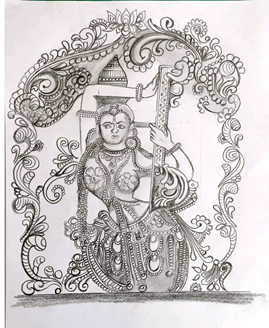
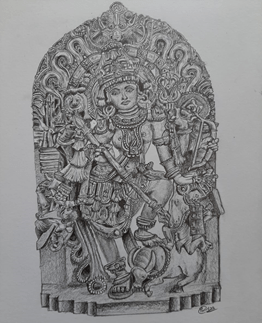
Indian art consists of a variety of art forms, including painting on a variety of handmade canvases, using nature-based media, sculpture, pottery, and textile arts such as woven silk. A strong sense of design is characteristic of Indian art and can be observed in its modern and traditional forms.
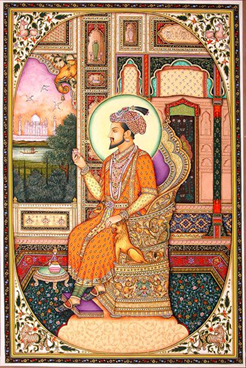
Miniature Paintings
These paintings are characterized by its miniature size but intricate details and acute expressions. Originating in the Mughal era, around 16th century, Miniature paintings are influenced by Persian styles. Later, it was adopted by Rajputs, and is now popularly practiced in Rajasthan. As with other art forms, the paintings depict religious symbols and epics. These paintings stand out as humans are portrayed with large eyes, a pointed nose and a slim waist, and men are always seen with a turban. They were profoundly influenced by Indian literature and were executed as illustrations to texts or as individual paintings. They were small-scale, highly detailed pictorial compositions, often providing a true record of the social and cultural life of the time.’
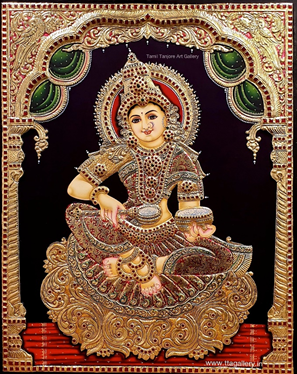
Tanjore Art
From down South, Tanjore or Thanjavur paintings originated in 1600 AD, encouraged by the Nayakas of Thanjavur. The characteristics of the Tanjore paintings are their brilliant colour schemes, decorative jewelry with stones and cut glasses and remarkable gold leaf work. Adorned with rubies, diamonds and other precious gemstones, and trimmed with gold foil, Tanjore paintings were true treasures. Nowadays, however, semi-precious stones are used in place of real ones, but the use of gold foil has not altered. The shine and glean on the gold leaves used by the Tanjore style paintings, lasts forever.
Madhubhani Painting
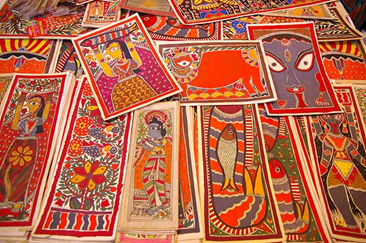
Madhubani painting, also referred to as Mithila Art (as it flourishes in the Mithila region of Bihar), is a traditional Indian folk art characterized by line drawings filled in by bright colours and contrasts or patterns. It is made on canvas, cloth or cow dung washed hand paper. Natural dye and mineral pigments are used in creation of Madhubhani artworks with geometrical figures and vibrant colours being key elements. This art form has five distinctive styles: Bharni, Kachni, Tantrik, Godna and Khobar.
Gond Art
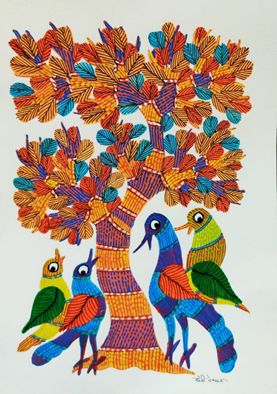
A native art form of Madhya Pradesh, Gond paintings are mostly themed on animals and birds. Practiced by the Gond tribes, this art form is believed to be more than1400 years old. Natural colours derived from plant sap, charcoal, coloured soil, cow dung, leaves, etc. are used to make this type of paintings. If you look closely, it is made up of dots and lines, diagonals, chains, crosses, tiny circles, or any other stroke that can be repeated thousands of times over. Today, these styles are imitated, but with acrylic paints.
Pattachitra Painting
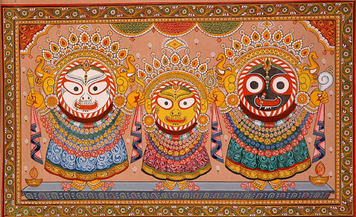
Pattachitra style of painting is one of the oldest and most popular art forms of Odisha. The name Pattachitra has evolved from the Sanskrit words patta, meaning canvas, and chitra, meaning picture. Pattachitra is thus a painting done on canvas, and is manifested by rich colourful application, creative motifs and designs, and portrayal of simple themes, mostly mythological in depiction. Women members prepare the glue, the canvas and apply colours what we call the fill-in and give the final lacquer coating. The male member draws the initial line and gives the final finishing.
Kalamkari
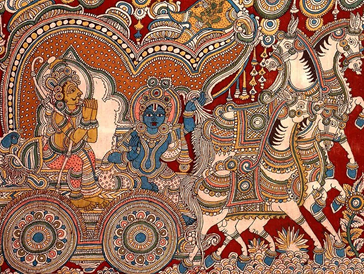
Literally meaning ‘drawings with a pen’, Kalamkari is of two types in India: Machilipatnam, which originates from Machilipatnam in Andhra Pradesh and Srikalahasti, which originates from Chitoor in the same state. While the former refers to block-printed form of art, the latter is a free-flowing art with a pen on fabric. Today, Kalamkari art is used on sarees and ethnic clothing, and depicts anything from flora and fauna to epics such as Mahabharata or Ramayana.
Phad
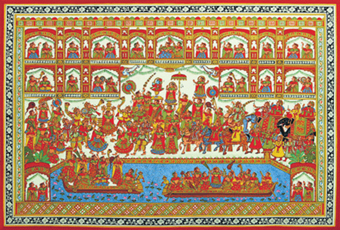
Originating in Rajasthan, Phad is mainly a religious form of scroll painting depicting folk deities Pabuji or Devnarayan. The 30- or 15 feet-long canvas or cloth that it is painted on is called Phad. Vegetable colours and a running narrative of the lives and heroic deeds of deities characterise these paintings. the depictions are usually of battlefield scenes, adventure stories, legendary romances, etc. The beauty of these paintings lies in the fact that many stories are accommodated in a single composition.
Warli Painting
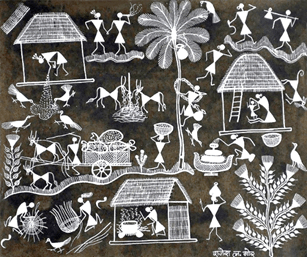
This form of art dates back to 2500 BCE, and it was practiced by the Warli tribes belonging from Thane and Nasik in Maharashtra. It is mainly the use of circles, triangles, and squares to form numerous shapes and depict daily life activities like fishing, hunting, festivals, dance and more. What sets it apart is the human shape: a circle and two triangles. All the paintings are done on a red ochre or dark background, while the shapes are white in colour.
Conclusion
Although several decades and centuries have passed, the rock paintings and stone paintings of India last long. There remain numerous unsolved mysteries in ancient paintings. Ancient Indian art teaches us not only the skills of traditional artists but also the natural elements they used for painting, without causing harm to the environment and to humans. The media they used were completely natural and eco-friendly unlike the media used nowadays. Some pigments, which they extracted from certain plants contained anti-microbial attributes, and others had medicinal properties. Even today, ancient Indian art stands apart from others, because of its unique styles and techniques. So, if we start involving deeply into these arts, we can discover more new information and we can develop our cultural heritage in the form of Indian art.
Written by Pavitra Ravi, Sankametra, Vinisha Angel Mary, Vekash, Mohamed Imthiyaz, Niranjana Devi, Anand Nirup.
 TEAM VARNAM