Introduction:
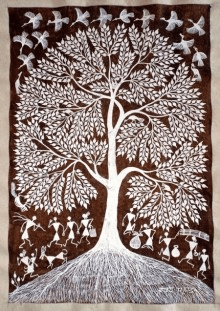
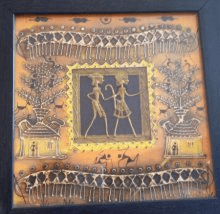
Warli is one of the oldest forms of Indian folk art and has its origins in the Warli region of Maharashtra. This form of tribal art mainly makes use of geometric shapes such as circles, triangles and squares to form numerous shapes depicting life and beliefs of the Warli tribe. In olden days, Warli art was done on walls on special occasions. The painting would be done over a brown background which would basically be a mixture of mud and cow dung cakes. The white pigment used to draw shapes and figures would be a mixture of rice mixed with water and gum. One of the most popular themes in Warli art is a spiral chain of humans around one central motif. This in accordance with their belief that life is an eternal journey, and it has no beginning and end.
Origin/History:
The Warli tribe is one of the largest in India, located outside of Mumbai. Despite being close to one of the largest cities in India, the Warli reject much of contemporary culture. The style of Warli painting was not recognized until the 1970s, even though the tribal style of art is thought to date back as early as 10th century A.D. The Warli culture is centered around the concept of Mother Nature and elements of nature are often focal points depicted in Warli painting. Farming is their main way of life and a large source of food for the tribe. They greatly respect nature and wildlife for the resources that they provide for life.
Theme:
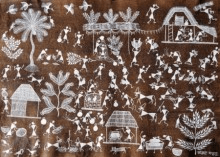
The theme of Warli painting is not mythological but rather activities of daily life like hunting, harvesting, dancing and sowing. There is evidence of the art finding its origins in cave painting from Neolithic times. When you look at Warli painting, the first thing that jumps out at you are the rudimentary shapes – circles, triangles and squares. The circle and triangle comes from their observations of nature. The circles represent the sun & moon and the triangle represent mountains and pointed trees. The square seems to be a man-made construct, representing a sacred enclosure of a piece of land. A “Devchauk” is a square frame with the sun, moon, a comb, a ladder & a tarpa around it. It is ornately decorated and depicts Palaghata, the goddess of fertility in the center. The most iconic theme in Warli painting is the Tarpa dance. The spiral design is made of up of men and women with a Tarpa player in the centre. In this dance, the Tarpa player directs the dance with his Tarpa, a trumpet-like instruments like a snake charmer. The men and women sway back and forth rhythmically in a concentric spiral, never turning their backs to the Tarpa player and moving clockwise or anti-clockwise depending on the notes being played. This unique shape is also said to symbolize the circle of life and death.
Materials used:
The walls are made of a mixture of branches, earth and red brick that make a red ochre background for the paintings. The Warli is only painted with a white pigment made from a mixture of rice flour and water, with gum as a binder. A bamboo stick is chewed at the end to give it the texture of a paintbrush. Warli artists use their clay huts as the backdrop for their paintings, similar to how ancient people used cave walls as their canvases.
Areas of establishment:
Warli painting is a style of tribal art mostly created by the tribal people from the North Sahyadri Range in India. This range encompasses cities such as Dahanu, Talasari, Jawhar, Palghar, Mokhada, and Vikramgadh of Palghar district.
These tribal paintings of Maharashtra are traditionally done in the homes of the Warlis.
Keeping the art form alive:
Traditional art forms these days need to be preserved and many have come forward to do it.One such saviour is Govardhan Eco Village in Thane district that makes an effort to keep this art form alive by providing Warli artists various platforms to display their art.
In February 2016, a group of Japanese artists adopted the Ganjad village in Palghar district in an effort to keep the art form alive. Many others are also doing their share in preserving it.
So, purchasing and promoting hand-painted Warli items seems like a fitting tribute to this one-of-a-kind art form.
Written by Shruthi R, Gokul Raj K, Narmada N, Mega S S, Loga Lavanya G and Krithiga.
 TEAM VARNAM
Nice work
LikeLike
Great artistic collage. Eager to see a ‘Warlike from u guys
LikeLike
Great artistic collage. Eager to see a ‘Warli’ from u guys
LikeLike